
Few things are harder for a family to face than a child diagnosed with a life-limiting condition. If you’re trying to understand childhood dementia life expectancy, you may be a parent, relative or friend searching for honest information during an incredibly difficult time. This article aims to explain, gently and clearly, what is known, while acknowledging that behind every statistic is a much-loved child and family. If you’re new to the subject, our overview of childhood dementia explains the conditions in more detail.
Please remember that general information can never predict any individual child’s journey. Your child’s specialist team is always the best source of guidance for your specific situation.
What is childhood dementia?
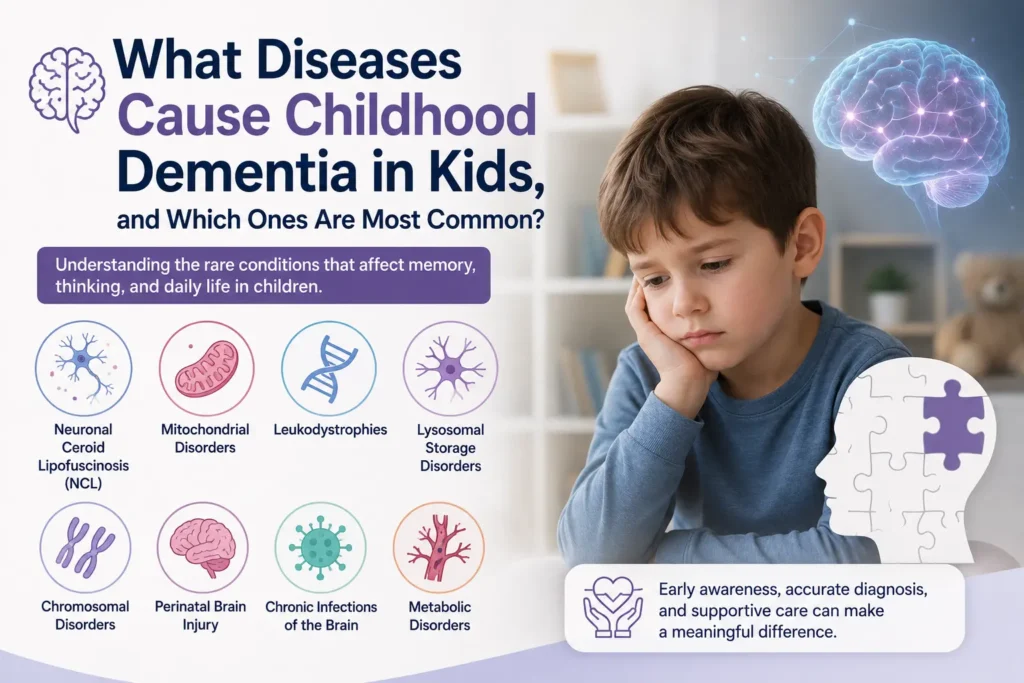
Childhood dementia is a term for a group of rare, genetic conditions that progressively damage a child’s brain, causing them to gradually lose skills and abilities they had already developed. It isn’t one single illness but an umbrella term covering many different disorders, including Batten disease, Sanfilippo syndrome, and certain mitochondrial and metabolic conditions.
The defining feature is developmental regression, where a child slowly loses abilities such as speech, movement and understanding. Because these are progressive conditions, they sadly shorten life, though how much varies enormously.
Why there is no single life expectancy
There is no single answer to how long a child with childhood dementia will live, because the term covers so many different conditions, each with its own course.
Some conditions progress rapidly in early childhood, while others advance more slowly over many years, with some children living into their teens or beyond, and a few into adulthood. Two children with the same named condition can also have different experiences, depending on the specific genetic changes involved and how the condition affects them.
This is why families should always seek guidance specific to their child’s exact diagnosis, rather than relying on general figures.
What affects Childhood Dementia Life Expectancy
Several factors influence the outlook for a child with childhood dementia:
- The specific condition and its subtype, as some progress faster than others
- The age when symptoms began, with earlier onset sometimes associated with faster progression
- How the condition affects vital functions such as swallowing, breathing and mobility
- Complications such as seizures, infections (particularly chest infections) and difficulties with feeding
- The care and support available to manage symptoms and maintain comfort and quality of life
Because these factors vary so much, prognosis is always individual.
Life expectancy in some of the more common conditions
While every child is different, it can help to understand that different conditions follow different patterns. Some severe infantile forms of certain conditions are associated with a much shorter life expectancy, while later-onset forms may progress more slowly over many years.
We’ve deliberately avoided listing specific numbers here, because they can be misleading and distressing when applied to an individual child, and because they vary by subtype. A child’s specialist team can give the most accurate, personalised information, and the disease-specific charities listed below can also offer detailed guidance.
The importance of an accurate diagnosis
Getting a precise diagnosis, the exact condition and subtype, matters enormously. It helps the medical team give families accurate information about what to expect, guides symptom management, and can open the door to clinical trials or specialist support.
An accurate diagnosis also helps families access the right services and connect with others facing the same condition, which many find a source of real comfort. It can guide decisions about school support, therapies and day-to-day care, and it allows families to plan ahead with clearer information rather than uncertainty. For some conditions, an early, precise diagnosis may also make a child eligible for treatments or clinical trials that would not otherwise be available.
Support for families
Facing a child’s life-limiting condition is one of the hardest things any family can experience, and no family should go through it alone. Support is available, both practical and emotional, and reaching out for it early can make the months and years ahead more manageable.
Children’s hospices, specialist palliative care teams, and disease-specific charities offer invaluable help, from symptom management and respite to emotional support and connecting families with others who understand. Many families find enormous comfort in speaking to others walking the same path, people who understand without needing it all explained.
Practical support matters too. As a child’s needs change, families often need help with everyday care, equipment, and simply finding time to rest. Respite care, where trained carers step in for a while, can give exhausted parents a chance to recover, spend time with their other children, or simply breathe. Reaching out for this support isn’t giving up; it’s making sure both the child and the whole family are cared for and supported through every stage of the journey.
Frequently asked questions
What is the life expectancy of a child with childhood dementia?
There is no single answer, because childhood dementia covers many different conditions, each with its own course. Some progress rapidly in early childhood, while others advance more slowly over many years. A child’s specialist team can give the most accurate, individual guidance.
Does childhood dementia always shorten life?
Most childhood dementia conditions are progressive and life-limiting, but how much they shorten life varies enormously between conditions and between individual children. Some children live into their teens or beyond.
What affects how long a child with childhood dementia lives?
Factors include the specific condition and subtype, the age symptoms began, how the condition affects vital functions like swallowing and breathing, complications such as seizures or infections, and the supportive care available.
Can anything slow childhood dementia down?
For a small number of conditions, specific treatments can slow progression, and supportive care can improve comfort and quality of life. What’s possible depends entirely on the exact diagnosis, so specialist advice is essential.
Where can families get support?
Children’s hospices, palliative care teams and disease-specific charities offer both practical and emotional support. The organisations listed below are a good starting point.
Where to find help and information
If your family is affected by childhood dementia, reaching out for information and support can make a real difference. The following organisations offer trusted guidance:
- The Childhood Dementia Initiative for information on childhood dementia as a whole
- The Batten Disease Family Association for Batten disease
- The MPS Society for Sanfilippo syndrome (MPS III)
- The NHS for general health guidance and to access care
You don’t have to face this alone. Your child’s specialist team and these organisations are there to support your family every step of the way.