Childhood dementia is a term used for rare diseases that gradually damage a child’s brain and nervous system. It is not one single illness. Instead, it describes a group of genetic and metabolic conditions that cause children to lose abilities they had already developed.
A child may learn to walk, speak, play and recognise familiar people, then slowly begin losing those skills. This process is called developmental regression. It is different from developmental delay, where a child learns more slowly but does not usually lose established abilities.
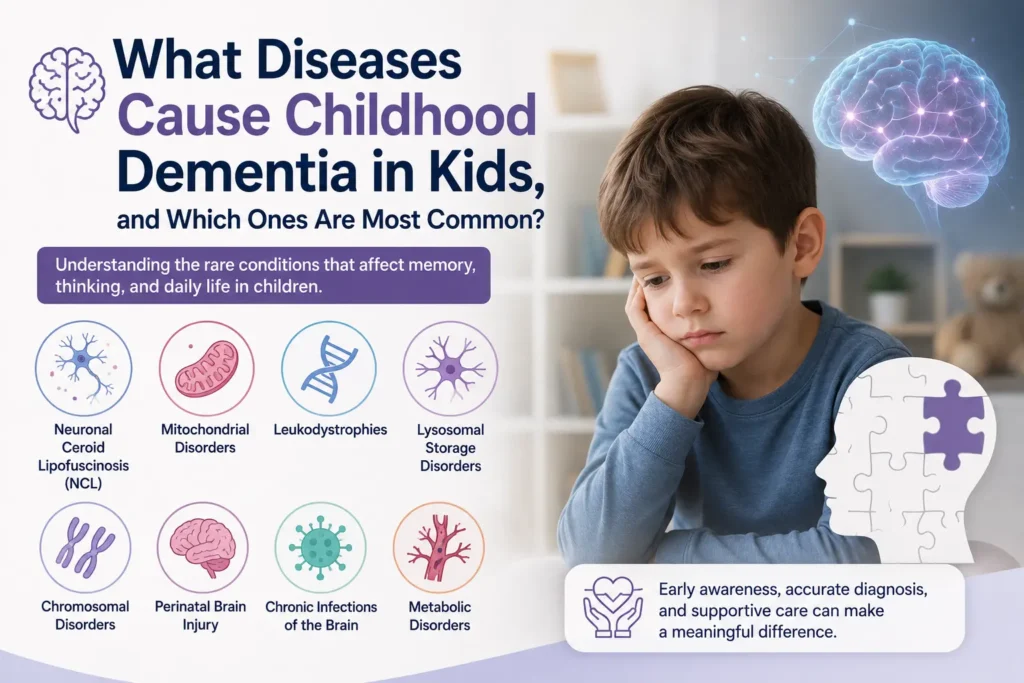
The main diseases linked with childhood dementia include Batten disease, Sanfilippo syndrome, mitochondrial disorders, gangliosidoses, leukodystrophies, peroxisomal disorders and Niemann-Pick disease type C. Some begin in infancy, while others appear later in childhood or adolescence. The Childhood Dementia Initiative, the leading global body for these conditions, brings more than 100 of these disorders together under one umbrella.
What Is Childhood Dementia?
Childhood dementia means progressive loss of thinking, memory, language, movement and everyday abilities because of damage to the brain.
The condition may affect several areas at once. A child can lose speech, balance, learning ability, social interest and independence. In some diseases, seizures or vision problems appear before cognitive decline becomes obvious.
The most important sign is the loss of a previously learned skill. Parents may notice that a child stops using familiar words, forgets routines, becomes unsteady, struggles at school, or needs help with tasks they once managed alone.
Childhood dementia can progress at different speeds. Some children decline over months, while others lose abilities gradually over many years. The exact pattern depends on the underlying disease.
Is There One Childhood Dementia Name?
There is no single childhood dementia name because the term covers many different disorders. Doctors aim to identify the exact condition, such as CLN2 Batten disease, Sanfilippo syndrome type B, Leigh syndrome or metachromatic leukodystrophy.
Finding the precise diagnosis matters because each disease has a different cause, treatment plan, progression rate and life expectancy. It can also guide genetic counselling, family testing, school support and access to clinical trials.
What Causes Childhood Dementia?
Most childhood dementia disorders are caused by harmful genetic changes. These changes may stop the body from making an important enzyme or protein. Without it, cells may fail to remove waste, produce energy, process fats, or protect nerve fibres.
The brain is especially vulnerable because nerve cells need constant energy and precise chemical control. When waste builds up, or energy production falls, brain cells become damaged and may eventually die.
1. Lysosomal Storage Disorders
Lysosomes act like recycling centres inside cells. They break down substances the body no longer needs. When a child lacks a specific enzyme, unwanted material builds up inside cells. Over time, this damages the brain and other organs.
Batten disease, Sanfilippo syndrome, GM1 gangliosidosis, Tay-Sachs disease, Sandhoff disease and Niemann-Pick disease type C are examples.
2. Mitochondrial Disorders
Mitochondria produce energy inside cells. Mitochondrial disease can cause seizures, weakness, balance problems, sensory loss and regression. Some children worsen during illness or physical stress.
3. Leukodystrophies
Leukodystrophies damage myelin, the protective covering around nerve fibres. Myelin helps messages travel through the brain and body. When it breaks down, children may develop walking problems, muscle stiffness, speech loss, behaviour changes and cognitive decline.
Metachromatic leukodystrophy, Krabbe disease and childhood cerebral adrenoleukodystrophy belong to this group.
Which Childhood Dementia Diseases Are Most Common?
There is no single worldwide ranking because these diseases are rare and are often recorded under their individual names.
However, UK research into children with progressive intellectual and neurological decline has identified several important groups. These include mitochondrial diseases, neuronal ceroid lipofuscinoses, gangliosidoses, mucopolysaccharidoses and peroxisomal disorders.
Mitochondrial disorders form one of the largest broad categories. Batten disease is one of the best-known inherited neurodegenerative groups in children. Sanfilippo syndrome is also widely associated with childhood dementia because it causes severe progressive loss of language, learning and independence.
Rates vary between populations, but mitochondrial disorders, Batten disease and Sanfilippo syndrome are important causes.
Batten Disease
Batten disease is the common name for a group of inherited conditions called neuronal ceroid lipofuscinoses. These disorders cause proteins and fats to build up in brain and eye cells. Different forms begin at different ages. The UK charity the Batten Disease Family Association offers detailed information and family support.
Common symptoms include seizures, vision loss, poor balance, movement difficulties, speech loss, learning decline, muscle stiffness, and swallowing problems.
CLN1 can begin in infancy, CLN2 often appears between ages two and four, and CLN3 may begin later with vision loss.
1. CLN2 Batten Disease
CLN2 disease is caused by a shortage of an enzyme called TPP1. Early signs may include language delay, seizures, frequent falls, and poor coordination. As the disease progresses, speech, walking, vision, and thinking abilities decline.
Cerliponase alfa can slow motor and language decline in eligible patients, but it cannot repair existing damage.
Sanfilippo Syndrome
Sanfilippo syndrome is also called mucopolysaccharidosis type III, or MPS III. Children with this condition cannot properly break down heparan sulphate, a complex sugar molecule. It builds up inside cells and progressively damages the brain. The MPS Society provides specialist support and information for families affected by all types of MPS III.
There are four main types: A, B, C and D. Each type is caused by a different enzyme deficiency. Early signs can include delayed speech, hyperactivity, poor concentration, sleep problems, hearing difficulties and frequent infections.
Later, the child may lose language, understanding, mobility and independence. Seizures, swallowing difficulties and breathing problems may also develop.
What Does Leni’s Childhood Dementia Mean?
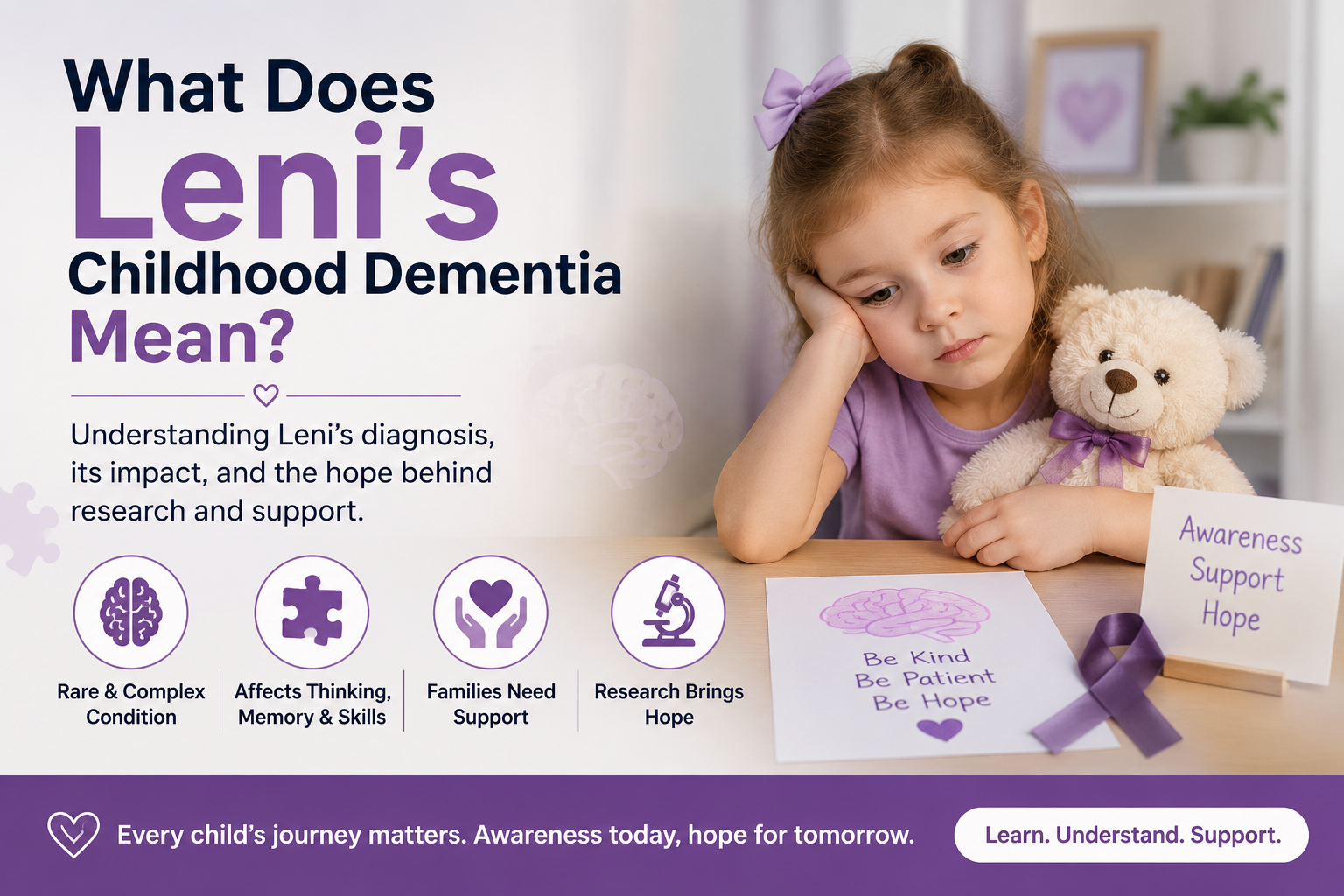
The search phrase ‘Leni childhood dementia’ refers to Leni Forrester, a UK child whose family publicly discussed her diagnosis. Leni has Sanfilippo syndrome type B, also called MPS IIIB.
Leni is the child’s name, while Sanfilippo syndrome type B (MPS IIIB) is the medical diagnosis. Her story raises awareness but cannot predict another child’s illness.
Mitochondrial Diseases
Mitochondrial diseases are a large group of genetic disorders that affect cellular energy production. The brain’s high energy needs make it especially vulnerable.
Symptoms may include developmental regression, seizures, muscle weakness, poor balance, abnormal movements, vision loss, hearing loss, feeding problems and breathing difficulties.
Other organs may also be affected. Examples include Leigh syndrome and POLG-related diseases. Testing may include genetic analysis, scans and organ assessments.
Gangliosidoses
Gangliosidoses are inherited lysosomal storage disorders. Unprocessed gangliosides collect inside nerve cells and damage the brain and spinal cord.
Important examples include GM1 gangliosidosis, Tay-Sachs disease and Sandhoff disease. Severe infantile forms may cause muscle weakness, low muscle tone, loss of head control, feeding difficulties, seizures and visual decline.
Later forms may affect speech, learning, movement and behaviour.
Leukodystrophies and Peroxisomal Disorders
Leukodystrophies damage white matter and myelin. Metachromatic leukodystrophy can cause walking problems, muscle stiffness, speech loss, seizures and swallowing difficulties.
Childhood cerebral adrenoleukodystrophy mainly affects boys. Early signs may include poor school performance, reduced attention, behaviour changes, clumsiness and vision or hearing problems.
Decline can be rapid. Children carrying the genetic change may receive regular scans to detect early brain changes.
Niemann-Pick Disease Type C
Niemann-Pick disease type C affects the movement of cholesterol and other fats inside cells. Symptoms can begin at almost any age. Some children first develop liver or spleen problems before neurological symptoms appear.
Common signs include unsteady walking, slurred speech, learning decline, seizures, swallowing problems, and difficulty moving the eyes quickly up or down.
Strong emotion may trigger sudden muscle-tone loss, while cognition declines progressively.
Childhood Dementia Symptoms
Childhood dementia symptoms depend on the underlying disease.
Early warning signs may include:
- Loss of words or communication
- Development slowing or stopping
- Difficulty following familiar instructions
- Falling school performance
- Behavioural changes
- Severe sleep problems
- New seizures
- Unexplained falls
- Poor balance
- Muscle weakness
- Vision or hearing changes
- Feeding or swallowing difficulties
Later symptoms may include severe speech loss, inability to walk, frequent seizures, muscle stiffness, breathing complications and complete dependence on carers.
Symptoms differ: seizures, vision loss, sleep problems or school decline may appear first.
How Is Childhood Dementia Diagnosed in the UK?
There is no single test for childhood dementia. Because symptoms overlap, diagnosis may take time. Parents can help by recording changes with dates, videos and examples from home or school. A clear timeline shows whether the child is learning slowly or losing established skills. It also helps specialists choose suitable genetic, metabolic, imaging and neurological tests without unnecessary delay during assessment.
Doctors investigate the child’s pattern of regression and search for the exact disease. They will ask when the child first sat, walked, spoke and completed everyday tasks. Parents should explain which abilities were lost and when the changes began.
School reports, videos and a written timeline can help.
Investigations may include:
- Neurological examination
- Developmental assessment
- Blood and urine tests
- Enzyme testing
- Genetic panels
- Exome or genome sequencing
- MRI brain scans
- EEG testing for seizures
- Eye and hearing examinations
- Swallowing assessments
- Heart, liver and breathing checks
Developmental regression should be treated as a medical warning sign and assessed promptly.
Can Childhood Dementia Be Treated?
There is no single cure for all childhood dementia diseases. Treatment often controls symptoms, preserves comfort and supports remaining abilities.
Care may include anti-seizure medicines, physiotherapy, occupational therapy, speech support, communication devices, sleep treatment, nutritional care, tube feeding and respiratory support. Families managing a child’s complex needs at home sometimes also rely on practical in-home care and respite support to help them through day-to-day life and to take a break when they need one.
Some metabolic disorders respond to diet or medicines, while selected leukodystrophies may need early stem-cell transplantation.
Enzyme replacement and gene therapies exist or remain under study, with access depending on diagnosis and NHS rules.
Families should be cautious of websites promising guaranteed cures or unproven treatments.
Childhood Dementia Life Expectancy
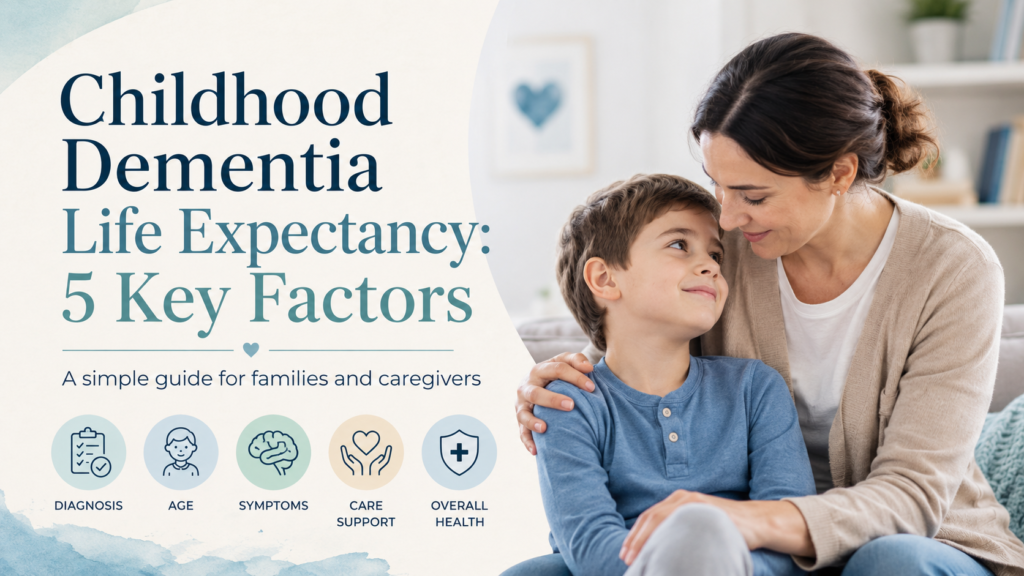
There is no single childhood dementia life expectancy. The outcome depends on the disease, genetic subtype, age of onset, speed of progression and available treatment.
Some severe infantile conditions cause early death, while others progress into adulthood. Life expectancy may also be affected by seizures, swallowing problems, breathing complications, chest infections and heart or liver disease.
Families should seek disease-specific guidance from their specialist team.
When Should Parents Seek Medical Help?
Parents should seek prompt medical advice if a child loses a skill they previously had. Examples include speech loss, unsteadiness, repeated falls, school decline, seizures or swallowing problems.
In the UK, parents can contact their GP, health visitor, community paediatrician or hospital team. Explain that established abilities are being lost. You can also find guidance on when and how to get help through the NHS. Call 999 if a seizure lasts five minutes or longer, repeats before recovery, causes breathing difficulty or follows a serious injury.
Frequently Asked Questions
Is Childhood Dementia One Disease?
No. It is an umbrella term covering many genetic, metabolic and neurodegenerative disorders.
Is Batten Disease a Form of Childhood Dementia?
Yes. Batten disease causes progressive brain damage, seizures, vision loss and loss of movement and cognitive abilities.
Is Sanfilippo Syndrome a Childhood Dementia Disease?
Yes. It progressively damages the brain and can cause speech loss, behaviour changes and declining independence.
Is Childhood Dementia Inherited?
Most childhood dementia conditions are genetic. The inheritance pattern depends on the exact disease.
Can Childhood Dementia Be Prevented?
Parents cannot prevent an inherited genetic change. Early diagnosis may allow treatment in certain conditions, and genetic counselling can explain future pregnancy risks.
Why Is Early Diagnosis Important?
Early diagnosis may provide treatment, better symptom control, specialist monitoring, educational support, genetic counselling and access to clinical trials.
Conclusion
Childhood dementia is a broad term for rare diseases that progressively damage a child’s brain. Important causes include mitochondrial disorders, Batten disease, Sanfilippo syndrome, gangliosidoses, leukodystrophies, peroxisomal disorders and Niemann-Pick disease type C.
The defining warning sign is developmental regression. A child begins losing language, movement, learning, or everyday abilities that were already established.
No single disease is universally the most common. Mitochondrial disorders form one of the largest broad groups, while Batten disease and Sanfilippo syndrome are among the best-known causes. Any loss of established skills needs prompt medical assessment.
An exact diagnosis can guide treatment, family testing, school support and future planning, giving families clearer answers and an appropriate care plan.