
If you are starting to look into care for someone you love, one question is usually at the front of your mind: how much does a live in carer cost? In 2026, live-in care in the UK typically costs around £1,200 to £1,600 per week for one person, with higher fees for complex needs. This guide explains what affects the price, what is included, what may cost extra, and what funding support could help.
The good news is that live-in care can be more affordable than many families expect. For couples especially, it can compare very favourably with residential care, because one carer may be able to support two people at home instead of paying two separate care home fees.
Live-in carer cost: the short answer
In 2026, the cost of a live-in carer in the UK typically ranges from around £1,200 to £1,600 per week for one person. For more complex needs, such as advanced dementia or care that needs two carers, it can rise to £1,800 a week or more.
To put that in everyday terms, that works out at roughly £170 to £230 a day for round-the-clock support, companionship and help with daily life, all in the comfort of your own home. Prices tend to be a little higher in London and the South East and a little lower in other parts of the country.
If you would like a clear figure for your own situation, the simplest way is a free, no-obligation chat. Call us on +44 333 004 0106, and we will talk it through with you.
What is included in the price
It helps to know exactly what your weekly fee covers. With most live-in care, the cost includes:
- a fully trained, DBS-checked carer living in the home
- help with personal care, washing, dressing and hygiene
- support with medication
- meal preparation and help with eating well
- light housekeeping, laundry and shopping
- mobility support and help moving safely around the home
- genuine companionship and emotional support
- a personalised care plan that is reviewed as needs change
In other words, the weekly figure is not just for a person in the house. It is for trained, around-the-clock support shaped entirely around your loved one.
What costs extra
A good provider will always be upfront about this before you commit, so there are no unwelcome surprises later.
- The carer’s meals. Your live-in carer eats in the home, so food costs a little more across the week.
- A second carer. If someone needs two people to help them safely or needs waking care through the night, the cost rises.
- Specialist care. Advanced dementia or complex medical needs may cost more because they need extra training and experience.
- The carer’s break cover. A live-in carer needs regular breaks and time off, usually covered by a second carer, which is built into ongoing arrangements.
None of these are hidden costs — they’re simply things worth understanding clearly before you make any decisions.
What affects live-in carer costs
No two care arrangements are quite the same, so the cost of a live-in carer depends on a few things:
- The level of care needed. Help with everyday tasks costs less than complex or medical care.
- Whether one or two carers are required. Most people need one; some need two.
- Specialist needs. Conditions like advanced dementia or Parkinson’s may need a specially trained carer.
- Location. Care in London and the South East tends to cost a little more than elsewhere.
- Day and night needs. Someone who sleeps through usually costs less than someone who needs waking support overnight.
Because of all this, the honest answer to “How much does a live-in carer cost per week?” is always “It depends” until someone understands the full picture. That is exactly what a free assessment is for.
Live-in carer cost for couples
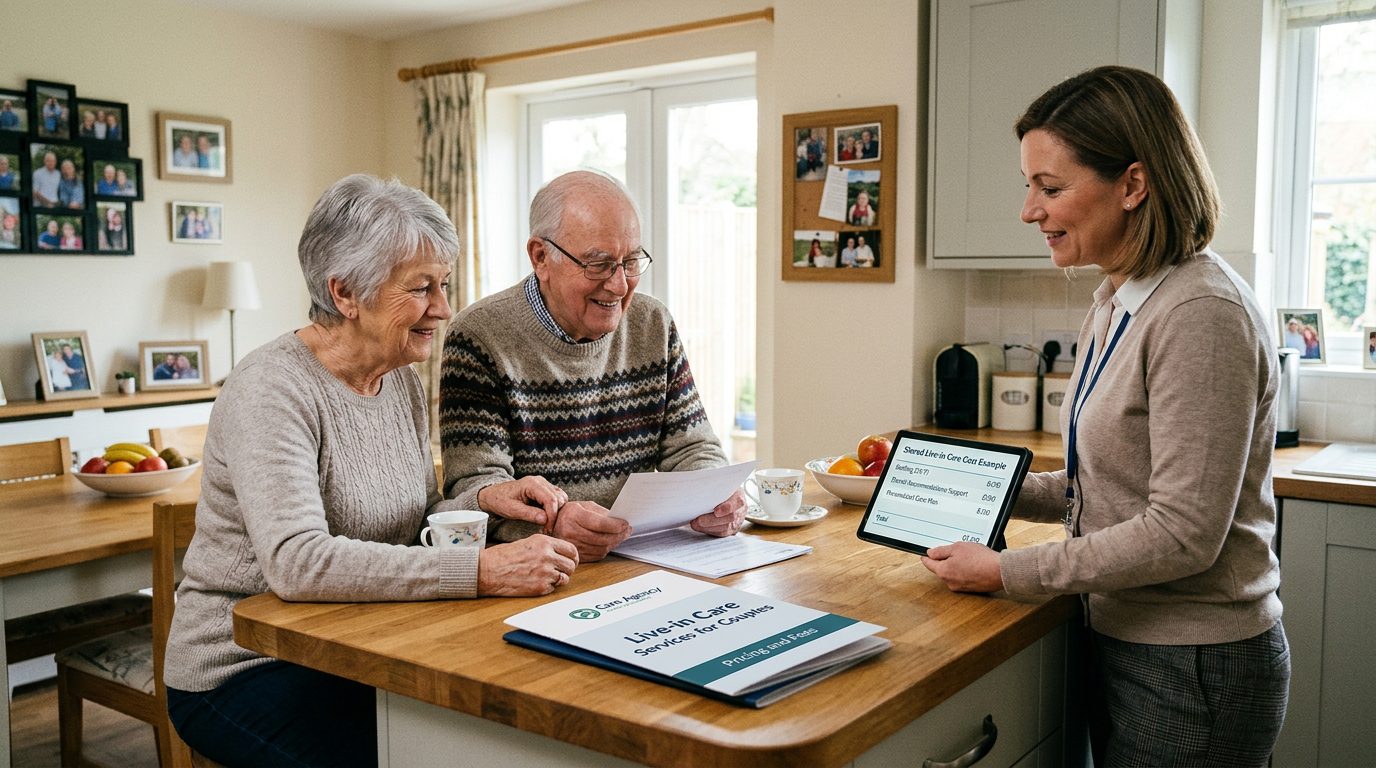
Here is something many families do not realise: live-in care can be remarkably good value for couples. Because one carer can often support two people in the same home, the cost for a couple is usually only a little higher than for one person, rather than double.
Compare that with a care home, where a couple would typically pay two separate fees, and living in care starts to look very sensible indeed, with the added comfort of staying in your own home together. For many couples who simply do not want to be separated, it is the kindest option as well as the most affordable. And if you only need cover for a short period, such as while a family carer takes a break, respite care can be arranged too.
Live-in care vs a care home: a cost comparison
It helps to see the options side by side. Here is a rough guide to 2026 costs in the UK:
| Type of care | Typical cost | Best for |
|---|---|---|
| Visiting (hourly) care | from around £20 per hour | A little help each day |
| Overnight care | from around £100 per night | Nighttime support |
| Live in care (one person) | £1,200 to £1,600 per week | Full-time support at home |
| Live in care (couple) | often only slightly more | Couples staying together |
| Residential care home | £1,000 to £1,500+ per week | Care in a residential setting |
| Nursing home | £1,300 to £2,000+ per week | Care with nursing needs |
The figures show why, for many families, live-in care is competitive with a care home while keeping your loved one in familiar surroundings with one-to-one attention. You can read more on our live-in care page or explore lighter options like visiting care and overnight care if full-time support is not yet needed.
Help paying for live-in care
Live in care is a significant cost, but you may not have to cover all of it yourself. Several types of funding can help.
Local authority funding
If the person needing care has savings and assets below £23,250 in England, the local council may contribute towards the cost after a needs assessment and a financial assessment. Importantly, if care is provided in your own home, the value of your house is not counted in this assessment. Anyone can ask their council for a free needs assessment, and it is a sensible first step.
NHS Continuing Healthcare
If someone has significant or complex health needs, they may qualify for NHS Continuing Healthcare, which fully funds their care, including care at home. It is not means-tested, so it does not depend on savings. It can be difficult to qualify for, but if your loved one has serious medical needs, it is well worth requesting an assessment.
Attendance Allowance
Attendance Allowance is a benefit for people over state pension age who need help with personal care, and it is not means tested. At the higher rate it is worth over £5,900 a year, which can be put towards live-in care costs. It will not cover the full amount, but it makes a real difference as part of a wider funding plan.
Direct payments
If the council agrees to help with funding, you can ask for direct payments. These give you a cash sum to arrange your own care, so you can choose a trusted local provider rather than being assigned one. For families who want more say in their loved one’s care, this can be a real benefit.
What different budgets look like in practice
Sometimes a real example makes things clearer than any range. Here are three simple illustrations:
- Margaret, 82, early dementia. Needs help with washing, meals, medication and company through the day, and reassurance at night. A single live-in carer at around £1,300 a week keeps her safe and settled in her own home.
- John and Pat, a couple in their late 70s. John has mobility problems, and Pat is becoming forgetful. One live-in carer supports them both for only a little more than a single rate, far less than two care home places.
- David, 75, after a stroke. Needs more intensive support and waking help at night. With a higher level of care, the cost sits nearer the top of the range but still keeps him at home where he wants to be.
These are illustrations rather than quotes, but they show how the cost reflects the real level of support, not a one-size-fits-all price.
Live-in carer costs in Barking, East London and Essex
If you are looking for live-in care closer to home, costs in Barking, East London and Essex sit broadly in line with the national picture, perhaps slightly above the UK average given the London area, but are generally better value than in central London.
As a local provider, Black Horse Care offers honest, transparent pricing and carers who genuinely know the area. You can learn more about what a carer actually does day to day in our guide to the role of a live-in carer. Rather than quote a one-size-fits-all figure, we prefer to understand your loved one’s needs first, then give you a clear, fair price with no hidden surprises. We are always happy to explain exactly what you would be paying for and why.
When live-in care may not be the right option
Any provider worth trusting will tell you honestly when live-in care isn’t the right fit – even when that means recommending something else.
If someone requires constant clinical nursing intervention, such as management of a tracheostomy, complex wound care, or intravenous medication, a nursing home with qualified nursing staff on site around the clock may be the safer environment. Similarly, if a person needs two carers awake and active throughout the entire night, the cost and practicality of managing that at home may make a specialist care setting more appropriate.
There are also situations where someone is deeply socially isolated and would genuinely thrive in a communal environment with organised activities and daily interaction with peers, something a one-to-one home setting can’t always replicate.
Live-in care works best when the priority is familiarity, continuity, and one-to-one attention in a place that already feels like home. Where clinical complexity or social needs point elsewhere, an honest conversation about alternatives is always the right starting point.
Frequently asked questions
How much does a live-in carer cost per week?
In 2026, live-in care typically costs between £1,200 and £1,600 a week for one person in the UK, rising to £1,800 or more for complex needs such as advanced dementia or care requiring two carers. The exact figure depends on the level of support needed and where you live.
Can I choose who cares for my loved one?
Yes, with most providers. Many families find it helpful to meet a potential carer before care begins, and a good provider will take your preferences — and your loved one’s personality — into account when making a match. The relationship between carer and client matters enormously to how well the arrangement works in practice.
Does the NHS pay for live-in care?
Through NHS Continuing Healthcare, yes — for people with significant or complex health needs, the NHS can fully fund care at home regardless of savings. It can be difficult to qualify for, but it’s always worth requesting an assessment if your loved one has serious medical needs.
What is included in live-in carer costs?
The weekly cost covers a trained, DBS-checked carer living in the home and providing personal care, medication support, meals, light housekeeping, mobility help and companionship, along with a personalised care plan. The carer’s food and any second carer for night care or breaks may cost extra.
How can I reduce the cost of live-in care?
You may be able to claim attendance allowance, request a local authority needs and financial assessment, or apply for NHS continuing healthcare if there are significant health needs. Combining these funding routes can make life in care much more affordable.
Talk to us about live in care
Choosing care for someone you love is a big decision, and understanding the cost is an important part of it. We believe in being honest and clear, with no pressure and no hidden surprises.
If you would like a clear idea of what live-in care would cost for your family, call +44 333 004 0106 or book a free care assessment. We provide trusted live-in care across Barking, Greater London and Essex.